Mathematical Creations, Maths Art, Modular Origami, Maths and Art, Math Art, ideas for maths lessons, creative, end of term, A load of maths things to make.
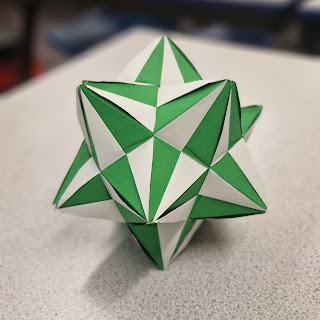
Lesser Stellated Dodecahedron
Get link
Facebook
X
Pinterest
Email
Other Apps
-
Lesser Stellated Dodecahedron
This uses the Super Simple Isosceles Triangle Unit by M. Mukhopadhyay/ Jeannine Mosely
Back to Philip Chapman-Bell (Oschene). This is his "Ten sided Yin-Yang Globe". There are a few versions of this on his Flickr account but the third looks to be the easiest and this is it. https://www.flickr.com/photos/oschene/6702378705/ https://www.flickr.com/photos/oschene/6702439719 He has put an image of a single unit onto his account and so I used that as many copies on an A4 sheet. The image of this is here. I have also found this being called "CandyWrap" by DutchPaperGirl on YouTube but it looks to me that she is using the image that Oschene shared originally for the template. 10 units (5 each in two colours) using the template above on A4 creates a model 6cm tall and about the same in diameter. To me it looks like it can be added to the list of "Festive" makes. :) Dutchpapergirl has a tutorial video here
Designed by Brian Beitel I have recently discovered Brian Beitel's website and videos on YouTube . This piece is called Balanced and uses 30 modules. I've used squares of paper that are green on one side and white on the other. It's nice to make and fits together well without glue. The instructions are here .
Snapology is method of creating objects using strips of paper folded up and linked together using other strips of paper. The process was invented by Heinz Strobl. His website www.snapology.eu has images and instructions. Other instructions are here https://www.instructables.com/How-to-make-Snapology-Origami/ and places like here . To be honest you can just search snapology origami and loads of instructions and images come up. Heinz Strobl's website also mentions that many researchers are developing structures and devices that can be on a large or tiny scale that use Snapology as its basis. This presentation has images of models that can be made based on Platonic and Archimedean solids, which might be helpful to see what things can be built. In the first image a selection, Tetrahedron (4 triangular faces), Icosahedron (20 triangular faces), Rhombicosidodecahedron (12 pentagons, 30 squares, 20 triangles) and snub dodecahedron ( 12 pentago...



Comments
Post a Comment